Graphic Accounts of 6 Ayahuasca sessions over 12 days on an island deep in the Peruvian Amazonian Jungle. August 10 to August 22, 2012
by Jeremiah Emanuel Josey
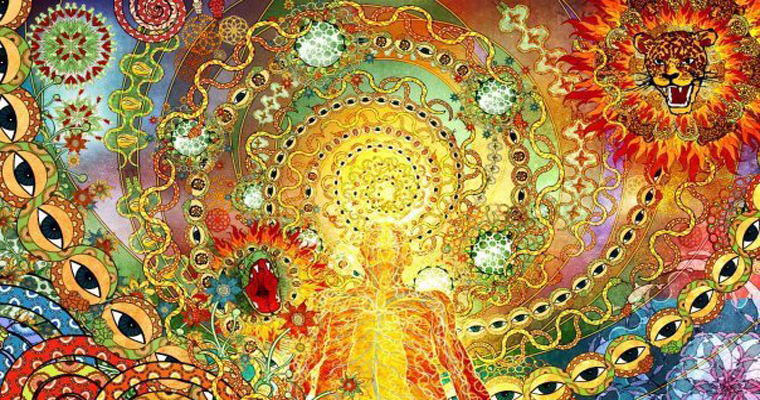
With Thanks
Leah Farbstein for terrific editing.
Jenny McDonald for her loving feedback on early drafts.
Kaja Zu and Dajana Stupar for being the first to describe the riveting, almost-like-we-there experience from the first draft.
Lucinda Randolph, the motivated to do more.
Forward
We ride in a machine. A complex, biological machine. Our body. Evolved over millions of years of harmonious development with our earth. Our home. Billions of years even, when considering the eons of practice and trial and error of assimilation of various elements: oxygen, carbon, hydrogen, nitrogen, calcium, phosphorus, potassium, sulphur and on and on and on, to bring our body to the level of development it has reached today. These bodies we inhabit are not from the Earth; they are the Earth. Small pieces of Her. In these bodies we spend a few short years of animation and emotion. Of mobility. A joy ride before it returns to the soil and the water and the air. Our mind, also a machine, residing in a different realm that which our bodies inhabit. Close to, but not close enough to see or feel or touch or taste or hear it. Non-physical. The mind’s very existence and our direct experience of it tantalisingly pointing the way to a world beyond the physical. A doorway. A gate way even. Between “here” and “there”.
Then there is our soul: the “who-we-really-are”. A unique piece of consciousness and yet immutably connected for eternity to one and all. This, our time on Mother Earth, is the journey of the soul, whilst riding in the body of a warrior, or saint, or priest, or lover or father or mother.
This is my journey, a warrior’s journey. Why a warrior? Because of the battle one wages with the self, the mind, and it’s creations are a battle. The battle that leads to the calm from where the truth is seen. The is the warrior’s way folds back the veil. I have learnt also that a warrior serves a different purpose. To protect those that cannot protect themselves.
Ayahuasca is nature’s’ way of talking to our bodies, to our minds. Showing us who we really are, what we are and where we can go.
Prologue
I have been writing and publishing online since the mid 90’s. This is a compendium of my experience written from daily notes taken during an Ayahuasca retreat at Nature’s Hospital, near Iquitos, Peru from the 10th of August 2012 to the 23rd of August 2012. I don’t believe that this particular venue is operating. My shaman was Don Alfredo, a veteran of 40 years, assisted by his wife, also a shaman, Claudia.
My notes became a book, because through reading over my short form notes my memory was coming back to me. There were many, many images, visions and thoughts, that happened in the 3, 4, 5, sometimes up to 9 hours that these experiences lasted.
Why should you read it? Why would you care about my experience? Well it’s not really for you. It’s still for me. By preparing a book on my experience, drafting, editing, drafting it again, publishing, this experience, my experience, works it’s way further into my consciousness as fact rather than as memory. I encourage you to do the same. Find a good shaman, a good place. Go on a journey within yourself. Come back. Live life fully.
Sharing my experiences with you may help you in your own journey. I know it will. Either toward the specific experience that I took or away from it. You’ll still have an experience. It may also help you decide to embark on your own Ayahuasca journey, seeking the right path to do so. There are many accounts of Ayahuasca experiences, those of Taylor Marie Smith and Graham Hancock were the most influential to me, and prompted me to take the journey that I am about to share with you.
Beforehand, I will say that I’ve never been interested in drugs per se. Alcohol is fun, highly socially acceptable, but not a habit. Tobacco is a fad long passed. Other plant-based chemicals, once in common use, now strangely persecuted in many of today’s disparate societies are not attractive either. Life is too much fun being fully aware. It wasn’t until I watched the documentary “DMT – The Spirit Molecule” in early 2012 that I realised, here was something that would give me an experience that would be useful for my life, here was an experience where I could look at reality from the other side of the mirror and see it for what it is, an illusion, whatever that means for you. After considering DMT further, I felt that only a guided journey into the realm would be satisfactory, or indeed even safe. I still maintain this. Unguided journeys with DMT, Ayahuasca, or any plant derived chemical compound for that matter, will place your soul in peril, or at least you’ll spend a few life cycles wondering what is going on. Always be guided. Either from this realm or another. But have the guide with you when you journey.
You will have your own views on why we are here, and what this is all about, and indeed what spirituality really is. For me, it’s living the best that one can possibly live.
Let us begin.
Day 1
Landing
The travel to Peru has been uneventful. Straightforward. Easy. A pleasant flight from Amsterdam. Pleasant conversation with my travel companion who was moving to Lima for 6 months to teach English. An overnight stay in Miraflores area. Pleasant walks along the high cliffs of that area. The Pacific Ocean is magnificent at sunset. The first time I’ve seen it from this side of the planet in the southern hemisphere. That massive expanse of water wrapping around most of our planet like a huge meniscus. Water is an amazing thing. And the sun disappearing over it. I am relaxed. It is pleasant.
The next day, I was off to the airport, and off to Iquitos. Back over the Andes from where I was the day before, and down into the jungle of the Amazon. I was the first out of the plane and then straight out of the tiny airport since I carried only hand luggage and I was sitting at the front of the plane. The time was around 7 pm but the sun was still quite high. It was an hour or so from setting so there was ample light. Brian from Nature’s Hospital was there to greet me. Of medium height and build, with his hair swept back into a shoulder length pony tail, his fair skin, and his mannerisms relaxed, obviously accustomed to the pace of life here. He also had the air of someone doing something important. And he was. He was a conduit. The ferryman. For folk like me traversing the planet to a very particular experience to take us far beyond the realities of this world. We didn’t find each other at first in that car park at the airport. We had never met before so after some walking around, it soon became obvious to him that the two meter tall wandering white gringo must be his charge for the next two weeks.
Next was a fun ride in the taxi. It was fun because initially I didn’t realise that this beat up, almost falling apart car was a taxi, so the first thing I did when seated was eagerly shake the hand of the driver as if he would be part of my two-week journey, a member of Brian’s team. He wouldn’t be. He was just the taxi driver. I realised this a few minutes later when I saw all the other beat up almost falling apart taxis milling around Iquitos. Our driver was a little embarrassed. I didn’t mind. I smiled. He gave a big toothy grin in return.
So we are in this taxi rolling in the direction that I assume is our destination. It’s too noisy to speak, the windows are down because the air conditioning doesn’t work and it’s too hot and too humid not to have the wind blasting through the car. There’s also the whine of the almost dead gearbox, rattling door frames and squeaking seats. I will also mention the dying engine gasping for life, the suspension long gone and the obviously out of balance and out of alignment wheels causing the entire vehicle to shudder at certain speeds as it speeds up and slows down as it descends and ascends the gentle slopes of the meandering asphalt before us. I ignore all of this and instead I admire the serene Amazonian jungle all around me, the scatterings of local dwellings and small farms, the setting sun and the blue, blue sky. The irony of the passage of this relic of a car stumbling along the man made asphalted two lane strip carved through the stillness of such an ancient and pristine jungle is very apparent. It is very beautiful. Then, with little warning – actually none – in the apparent middle of nowhere, on the road, on the “highway”, we stop. No pulling to the side. No indicators. Just slowing and stopping. Like the need to move just ceased to be important anymore, so hey, why not stop. So we stop. The engine stops too, but not really. It wants to keep running, like an engine does when it’s burning oil and heavily carbonised. So it sputters a few more moments before giving in to this moment of rest and the silence of the twilight jungle fills in around us. This is where we get out. There is no traffic. There are no street lights. Brian pays the driver and we commence what turns into into a brisk thirty minute hike through the jungle. Brisk because we want to reach the camp before night fall. I hear the driver behind us crank the engine into life and continue sputtering on his way. Then the quiet envelops us again. We enter the jungle on twilight and inside it becomes dark very quickly. After fifteen minutes we cannot see except for the light from a torch that Brian produces from his pocket. But the path is wide and relatively easy to traverse. I can see enough to guide myself following behind him.
Then we arrive.
The the clearing of the camp allows the twilight to reach the ground again. The place is amazing. Right in the middle of the jungle. I can look for a few minutes before the night descends once and for all. There is no electricity. Just lamps and candles. Introductions are made. There is only two or three people here. I meet Ben, also born in Australia, who arrived the day before. He’s working as a stunt double at an illusionist show touring South America and is taking some time out. It turns out he lives walking distance from a place I used to live in Australia from years before. It’s a small world. We talk for a bit, and then tired from travelling I retire to my bed.
I woke from the deepest, deepest sleep with giant urge to go to the toilet. Again! I’ve been going regularly since I arrived in Peru. I resolve to drink less water so late at night from now on. Living in the Middle East I am constantly drinking water. Now my body is dewatering. It’s still dark. I can sense that dawn is still far away. But I must pee! When I’m done I remember that I left my writing book in the kitchen and dining hut so I go up and retrieve it. The little torch that Brian lent me cuts powerfully through the dark like a silver spear. I feel a great sense of support walking between the buildings through the jungle. I’ve been in dark black places before where there was no support, in fact the opposite. Here it feels very safe. There are lots of frogs making noises. Birds too I later it is explained to me. And insects. Night in the jungle is not a quiet time and I sleep with earplugs. I can see the eyes of the frogs reflecting back my silver spear as I move it across the jungle. I return to bed and drop into deep sleep again. Yet again I am awaken by another huge urge to go to the toilet. I feel dawn is still far away. My body is definitely offloading excess water. I go out. The crescendo of frogs, birds and insects greets me again. Now the moon is out. A nice crescent, only one-third full. It filters through the jungle canopy and gives an eerie glow to everything. Though again I feel safe, supported.
This time I drop back into a deeper sleep before awakening.
Day 2 (Aya Night)
I am lying in bed and I am awake. It is very early. I can tell it is daylight, though it has barely arrived. Again the need to urinate is strong. I cannot stay long lying here.
I recall a vivid dream upon waking. In the dream I am asked by an unfaced, unknown person but I know that I know them, or at least they know me: “am I still in the business” and do I have the “thickening” – an image comes to my mind and the thickening is shown to me to be the connection between the left and right sides of my brain. I say “yes”. I am emphatic in my response. A little doubtful in my feeling. Then strong again as I know, I see.
As I lay in my bed I think about whether the others are awake and something else comes to my mind and then something else. There were three clear thoughts. No longer for my memory yet, very clear and vivid. Like realisations of events past. Clarity. Then gone. Assimilated into my being. The need for remembering not longer necessary. Already I can feel the jungle taking an effect on me.
I go to the toilet and when I come back I look at my watch and it is exactly 8 am. The second hand is coming up to the 12, less than 10 seconds to go. Breakfast time! I am very hungry. I have observed how when I have a clear thought or a feeling come to me and I glance at the time, it is a specific number, like 11:11, or 20:02, or 4:44. It’s like it’s a confirmation that that thought or feeling is ok, a good one. Follow it. So I do.
Breakfast is a beautiful affair of traditional locally sourced fruits and pulses. It’s all locally sourced. The low fat, no added sugar, no added salt regime for Ayahuasca that has invigorated for the past few weeks, continues now. I am feeling very light in my body.
One of the guests who arrived yesterday is Marco who has lived in Iquitos for the past 5 or so years. He comes to join in the ceremony for tonight. He is from somewhere in the USA. After breakfast he shares with me a cigar from locally grown tobacco leaves. Organic. It is very fresh. The life of the tobacco plant still oozes from the leaves. The taste? It’s smoke. I still don’t like it.
After our morning discussion following breakfast we all head off to the creek for a plant bath with our shaman don, Don Alfredo. Don Alfredo is a small man, his frame efficient and lean with sinew. He is a Shipibo indian who could be in the native amazon immediately without disturbance to his demeanour. His skin dark brown and a fine leather. His eyes smile in a piercing yet friendly way. Knowledgeable and supporting. All seeing. It’s good to stare back into those knowing eyes. No secrets here. He is in his 50’s and has been a Shipibo shaman for more than 40 years, since he was a small boy. His grandfather took him into the craft and his grandfather still guides him to this day, from the other side.
For the plant bath Don Alfredo has collected the leaves and flowers of a number of plants. He has torn them by hand – by hand is important he says, to be connected – into smaller pieces and stirred them with by hand – connected – this way and that in a half full bucket of water. Water from the creek. Cold water. We line up in the creek and with a blessing Don Alfredo turns the plant infused water onto each of our heads in turn until it has all gone. It has an invigorating feel, energising. More than the feeling of cold from the water alone. He instructs us to leave the plants remnants on us that have remained and wait for some time. Then we can shake them off. The energy of the plants can infuse into us in this way and it will prepare us for tonight’s first ceremony.
Day 3 (Recounting the Ceremony from the Night Before)
First Big Hit
We begin to gather in ceremony hut around 9 o’clock in the evening. The hut is large and circular with the roof high above us. The green insect netting gives the enclosure a secure feeling, although it is just netting and the jungle is all around us. It feels good. It is constructed entirely from jungle trees and the thick, wide, green, uncured, timber boards on the floor feel cool and supportive. Very supportive as I will find out on a later night. There are about nine people in the hut including myself. Six or seven of us will take the aya medicine tonight. We find ourselves provided with plastic covered mattresses (the plastic cover is a good thing, for the reasons revealed later!), a blanket and some cushions. I take a place two places from the doors but the space is free between myself and the entrance. Don Alfredo and his wife Claudia are directly opposite the entrance, about 3 or 4 mattress places around from me. They have small accoutrements next to them – cups for the Ayahuasca, candles, matches, tissues, scented oil, the Ayahuasca. All are either on a small table or around them. They are sitting and smiling. Occasionally moving or adjusting something around them.
Slowly everyone gathers in the hut and we settle onto our mattresses. There is a candle burning in the centre of the hut providing light for all.
Then Don Alfredo lights a cigarette and begins to blow smoke. He stands and moves around us slowly blowing smoke over and around us. Clearing the spirits we are told. Then from his table he takes a bottle with lightly transparent brown scented oil – a concoction with plants. He takes a small mouthful and blows it directly onto the crown of each of us with a burst of his breath. It is cool and fresh when it hits my scalp. Now he is cleansing us, clearing us for the ceremony. He speaks a little in Shipibo and instructs us in spanish to have an easy night. Brian is translating for us. It is time to relax, take it easy and let mother Ayahuasca do her work. Then, one by one, we each move up and take a cup of Ayahuasca from the don.
It is my turn and I take the cup. It smells vile. In one gulp I drink it all and it is vile. I want to gag immediately, but I hold it down, my head shakes and convulses in reaction to it. I go and sit down and using my will power I keep the brew inside me. Then, once I feel the gag reflex has subsided I allow myself to relax and I go with it. I feel my body move and let myself move and flow with it. I am rocking from side to side, with only the slightest conscious attention to do so. The Don is gently singing. Shipibo music. Shipibo magic. My head is gently rocking, moving. I am aware of the moving. I am aware of the attention I am putting on the moving, and I am following the feeling. This way, that way. It feels like I am guided, and I am watching. Then suddenly after a period of time I can’t recall, I feel a jolt. A shake. Something has “arrived”. Arrived in me. Landed in me. It is a real physical sensation. The shock I feel in both my mind and body. My thoughts are loud to myself, “who, or what is this?” I decide to observe. I think to myself: “this will be fun to see what happens”. A decision I am soon to regret. I can hear buzzing and my body sits up to hear it better. My body moves but I do not feel in control of my body now. I am not in control. The “Arrival” now controls it. I listen, rather the Arrival is listening. I am watching from somewhere that feels like now a passenger. A passenger in my own body. I am just watching. The “Arrivee”. Just as I can observe the Arrival, I can also feel their distinct amazement and wonder at this experience. The thought “it worked!” comes to me. I feel, rather I know that this is the thought of the Arrival. It is oblivious to my presence. It is focused entirely upon my body – the body it now controls. Then it moves my body a little and it is feeling my body as if for the first time. I feel it’s attention on my left ear and my ear clicks and changes itself like my Arrival wants to have the hearing ability that it is used to having. Because I am still in my body, I observe my own hearing intensify incredibly. The sounds around me have intensified. They have not become louder. Much more acute. I am hearing the faintest sounds that appear to come from kilometers away as if they are next to me. I look with my eyes, rather the Arrival looks with my eyes. All is darkness, black, yet I can feel the wonder coming from the Arrival at being able to see. It is seeing something I cannot. Again I am passenger in my own body.
Then a huge convulsion takes over me and I vomit. Spontaneously. Uncontrollably. The feeling, the thoughts then come over me: “It’s here! We are here! We have arrived! We have travelling far and we have arrived”. Who has? I don’t care. I am vomiting. Strong retching that convulses my entire body. (We have buckets too). Then I stop. I try to take back my body but the Arrival does not want to let it go. The Arrival almost ignores me, giving me a only a passing faint thought to keep me as the passenger. I feel like I have no power. Zero. The Arrival sits my body up and using the fingers of my right hand runs them down my outstretched left arm. It is feeling the body it is in. Feelings of awe flood over me as I feel what it is feeling. The thoughts come past my mind, “yes, I have a body, I can feel it, and it feels great”. This feeling flows through me. I decided then that if I can’t control my body then I’ll control my mind and I follow the path of the thought and look into the mind of the Arrival. I see blue, cold blue. Dark skies and ice blue structures all around me. I feel a slight shock. My Arrival is extraterrestrial, from a place far from Earth, from a cold blue planet with pale blue light. I see sharp, smooth, angular surfaces towering around me. There is no wind. No water. Clean, irregular, sharp, all angles. Blue. The Arrivals’ other body is also blue, a dark metallic like blue. It has a hard shell. Not soft like my skin. It is like an exoskeleton. It could be a covering of some kind yet it feels such integral part of my Arrivals other body that this is how it has evolved on this blue cold planet.
Then something new happens to me. It feels like I drift away for a few moments. I think I become unconscious, though no more than for a few seconds. A change happens now. The blue Arrival leaves, disappears, and is replaced or is displaced by another one, a massive one. I have no time to realise what has happened, as control of my body passes from one form to another. I think briefly that the Ayahuasca has opened a doorway and entities are popping into and out of my body. A much darker form has arrived now. There is no more cold, yet elegant, steel blue. It feels like it was simply pushed it out. This new one feels dark, demon like, ‘el diablo’ comes to me as a thought. It feels me totally, entirely. I am crowded in here now. In my own body! Why don’t I just pop out? I don’t know. These thoughts and feelings are flowing over me. They are not good feelings. I feel dread at them. I am convulsing again. Purging heavily. This time it feels like a birth. A birth of something. I can see a black, wet, newborn shape of some creature rising from my stomach. It struggles to push into my oesophagus, into my throat. It won’t fit. It is simply too big. It struggles, it howls, and I purge. Retching my body over. Fuck this is exhausting. After several huge attempts to purge I had a huge feeling come over me: “I have arrived. I am here. Bow down before me”. More huge purging and and I fall from my knees and onto all fours. like an animal. I can feel that el diablo is used to being on all fours. Crouching, the position felt so comfortable, so easy. Then in that position el diablo began to explore its senses, exploring its surroundings. Remember I am inside watching, as a passenger. Part of me strongly feels that I should take control and push el diablo out, however there is an inquisitive part of me that wants to watch. I have a feeling that this watching is dangerous for me, but I am more curious. I want to see more. El diablo has a body (mine), and I am crowded out, both of my body and my mind now. I am not pushed outside of my body or mind, I just feel that my mind and my body are very full, and the “me”, the “I” was pushed right to the boundaries by this thick, black, massive arrival, this entity. El diablo. However, I am still holding the intention to let this experience continue. Looking back now, this was a mistake. It was a strong lesson, to understand the strength of el diablo, and what I had to do to expel it. The being in me was here. Then began the task of putting this thing away, getting it out, of reclaiming my body. Yet I remained transfixed, intrigued. Who or what was this? So it lingered. Again I purged hard many, many times. Again it felt like a birth but now I could feel expulsion energy coming through from beyond me, outside of me, expelling the entity that had control of my body. I was expelling it. The jungle was expelling it. Ayahuasca was expelling it. But it was hard. I collapsed in vomit. It was all around me. El diablo thoughts came to me “yes, my birth waters!!” and feelings of “yes, this is my arrival signature”. My own thoughts came back and they were “no, this is me getting you out!”. I knew I needed help now.
Time for the Don
In the collapsed state I called for don Alfredo, weakly at first. No sound would come out of my throat. Then I knew I had to use my will power, all my strength to take control of my voice, that small part of my body, to make a sound loud enough to get his attention. I summoned my strength and overriding the control of el diablo I called out again and the Don heard me. Even though it was pitch darkness, nor could I hear any confirmation from him, I could feel his attention turn to me. I could see his attention. From then on, don Alfredo supported the slow extraction and control of this dark entity, expelling el diablo. However a new turn of events occurred and the new few hours turn into a containment exercise, not an expulsion process. El diablo is fighting. Hard. It will not go easily.
Reflections
Many thoughts come into my mind, thoughts as me and thoughts as el diablo. The thoughts switched rapidly, to and fro, from me to it. El diablo is powerful, arrogant. Often crouching on all fours, ignoring everything: me, don Alfredo, everything. During this time I am having many thoughts and many images are shown to me. What I share here are just some of them. Those that I remember. J, a woman from a recent relationship, came to me as mixed messages: she was seeking to obtain a child for the “devil” from me, she was also testing me. It was sad how it ended with us and I can feel this as my denial of my duties as a man. I still have to process fully what this means. I feel my friend K has become attracted to dark energy in me also, yet I can see the white light behind her. Strong and glowing. She is struggling with the darkness, not knowing that her mind was attracted to the sweetness of thought, like honey for a bee, yet without heart to guide, those thoughts lead straight to the demonic core. The strongest message coming to me is how many negative actions, attitudes, people, events have fed this demonic landing place in me for el diablo to arrive at. It needs this negative emotional portal to suck energy for it to feed in the darkness where it lived and give it a place where it could guide itself into reality. Using my body as a portal. A strong question as a feeling comes over me “why do I have such a big body”, and the answer came from el diablo, “for me!!!”. Later, as my strength increases this feeling changes to my own thoughts, “no, my body is big so that I can trap you!”. This was the warrior’s battle.
The Battle
At this point in the night there is a raging battle, in my mind and in my body, between the demon, el diablo, and I, both fighting for my body, for a reality, for an existence on this earth. With don Alfredo’s help I know I have the upper hand. Then my visions shift to an expanded universe. A very wide, thin line on a background of some faint star like clusters towards the middle, like galaxies. A feeling comes to me that I am outside the entire universe and I am looking back upon it from a long, long way away. All is dark around me. I am floating. Suspended. In nothing. Way off the left of me is don Alfredo and Claudia. They sit in their traditional shipibo clothing. He chants and she is close, and she sings, supporting him. Her head is down. Her eyes closed. Rocking to the rhythm of his music. Don Alfredo has his head up, looking across towards me. They float in space upon this line. There is a soft yellow light behind them both. It is radiating from some point behind and like shooting stars flows past them. I feel this great strength of support from both of them. I feel that the light coming from them is stripping evil from the darkness, tearing at it. Easily melting it with it’s soft loving touch. I can feel that this is happening to me also. A message comes to me – this is a battle of galactic proportions. “You have our support”. This comes not from don Alfredo and Claudia, but from “them”, others, a kind of council, a cosmic council. And a vague image, (vague because it is so distant), is of a bright light rising and dropping on this thin line that stretches across the universe. A Galactic battle. A feeling of “yes, this is it”, comes over me. And that I am the one to deal with this nemesis, this demon, el diablo. Then again I see lots of images of how this darkness was fed, how it was brought into existence. People love it. Certain people. They worship it. And these people fed off me as I gave them access to this energy. The rest is like a movie and is way too much for me to write. So much information. Except to know that it is all true and that it is all ok now. Images of people in ceremony preparing for the arrival of the demon, of “it” of “him”, of el diablo. They were preparing for him, and had been for years, with special rooms, robes, shines, book readings, chantings, all the images you see in movies, all the pomp and ceremony. I even see how Hollywood movies are preparing everyone for the arrival as well. Movies that deal with demons, Satan, and even just violent movies (with people being killed) feed the preparations. These images were coming to me. I would actually not need/to/want to remember. The key message was that everyone is good, and the bad things they do will hide the good while the demon god feeds off that energy. The battle continued in me – the galactic battle. Images if imprisonment for my demon appeared. It relented, I could feel it giving in, knowing it was beat. I continued to press, to fight it. I was a “galactic warden”, a galactic warrior. Another thought, one of my thoughts, was “I will dissolve you – the entity on my next aya journey. For now was containment and restraint for it”. A message comes to me: only I will understand this battle, this epic struggle to thwart the arrival of the demi-god I have called el diablo. Only I would appreciate the importance of this battle amongst people on earth, people with bodies. The message continued: not to worry about trying to explain it, or cry out about it, or even write about it [afterwards I realise the writing is to continuously remind myself of the journey I have taken]. The message continues: My job was to do the battle, and I was strong enough to do it with “their” support, and the support of don Alfredo and Claudia. No one else would understand it, nor could they understand it. The feeling was that now all those presently waiting for the return of the el diablo, of their “satan” would be frustrated in their plans. He was not coming any more. The Galactic Council: they understand. They watch the battle.
Don Alfredo calls Brian to bring me water. He was saying something in spanish to Brian and Brian responds. I can understand. Water is coming. The battle continues…
Intention in the Water: the Winning Move
People are walking around me and someone was using a red light – el diablo loves that deep red light. It snarls with contentment – using my mouth! It feels home in that light. This feeling rising up in me concerns the conscious me, that such a simple thing – a red light could give “it” so much power and confidence. Then a white light comes on and el diablo doesn’t like that. The light penetrated el diablo, causing pain. With the water on the way I can feel the clear, pure intention Alfredo was putting into that cup. El diablo shrieks silently inside me from the thought of taking that water into my body, it knows this is the end. But I take control of my body at this point with strong conviction. I know I must. Most of the night’s battle had me shaking and convulsing on the floor unable to control anything of my body for more than a few seconds as the demon was wrestling control of my limbs from me. With the water I drink and drink and drink. Then I purge. Again and again. More purges. Massive, gigantic, There is water everywhere. More than I drank. The mattress I am on is covered in water. The floor is soaked. I sit up. People are all around me. They are cleaning me, my area, my mat. I feel gratitude. Love. In the light I can only feel “battle zone” – the site of a great battle. Don Alfredo at one point takes my hand and pulls me up. He is pulling me up from the discarded dead body of el diablo, psychically. He places his hand on my head, and by simply raising his arm he raises my body, from my head. He lifts me to a near standing position. My back and neck is straight. My head is erect. I can feel his pure intention to have me stand. This feel very, very good, like the water I drank just minutes before. Everyone returns to their place. The lights go out. Now, after the blackness, that darkness has been removed from me, I feel clear, clean, purged. Waves of messages, support and congratulations come to me, not from those sitting around me in the ceremonial hut, but from afar, from the Council. I feel compelled to rise and acknowledge the adulation. It feels good to stand. I am very wobbly – it is like I am remembering how to control my body again, like I have forgotten how to do it. I muster my willpower and remaining strength and straighten my body, and steady the wobbling. I raise my left arm high above my head, my hand in a fist, as a salute the Galactic Council.
I have won. I can feel their acceptance of this. I sit down and cover myself with a dry blanket and lean against the wall. I am exhausted. Exhilarated. After a few minutes of feeling this new, cleansed me, I am compelled to lie down. I do, and I sleep, and the sleep is so good.
Below I have written a handful of notes. On the next day I recorded these flashes of memory as they came back to me. There were many more that I can not remember now. Those I have written here I have also elaborated with the feelings, emotions and the visions that accompanies them.
“I am the Bushmaster, the Master. Not you, you are not in control, I am.” At some point during the night I was fighting with the bushmaster. Big, dark and ominous. This sentence was part of its conversation with me. I replied saying “no, I am in control”. This was as I was regaining control of my body after the battle with el diablo was at an end. The bushmaster – Lachesis Muta – is a pit viper snake that lives locally. It is related to the rattlesnake, can grow up to 3 meters in length and whose bite is usually lethal to whom it inflicts. Whenever we go for walks into the jungle around us one member of our company carries a shotgun and all staff members carry machetes. “What for”, I asked once. “For the bushmasters”, was the reply. And I then learnt of the deadly reputation this venomous snake has in this jungle.
“Everyone can support me in this room, just from their presence”. At one point as the battle was being won I felt an incredible connection towards and with everyone in the room with me. The feeling was that they didn’t even need to understand what was going on. Just by their presence they supported me. Their spirits knew and that was a great support.
“I have support everywhere for this battle”. As I widened my awareness I could feel support from everyone and everything, not just in my immediate surroundings, but everywhere, the jungle, the island we were on, Peru, South America, the Earth, Ghia, the Universe. I could feel that there was support for me from everywhere, always.
“The darkness I can see anywhere now. Anywhere it exists I can see it. And it hurts my heart”. I was shown where the darkness enters me, enters other people, all humans. I was shown the pathways of how the darkness enters and how the energy is drained from us. How we become just like batteries for the darkness. The images, the movies, the actions, lifeless, synthetic foods, unguided drugs(1), everything that done in an unwholesome, lacking, harmful way is a doorway for the darkness. No wonder there is the saying the “devil” is everywhere. “He” really is! (2)
Footnote 1. All drugs are beneficial if you are guided and supported in the experience of them. Taken as a supplement to life, they are not beneficial.
Footnote 2. If you are interested to know about this, read “Outwitting The Devil” by Napoleon Hill, written in 1938 and published in 2011 – there is a reason for the delay in publishing.
“Intelligence can be an entry point for the darkness. It can fool an intelligent mind to go looking, and then set up a feeding circuit on the emotions that are generated, that the intelligentsia cannot feel – because they are too much in their head. It’s Catch 22”. This was a big lesson for me. This is partly why I was here, though not really – I have done so much work to get back into feeling again, however I was shown how simply and plainly that intelligence, especially high intelligence, created a cover, a shroud over the heart and drowned out it’s soft gentle tugging of the Truth, it’s feelings, with the noise, the spinning, the rambling truth made by the mind.
“The ignorance of man of how this process works is an entry point”. In the converse to high intelligence and also in parallel to it, lack of knowledge or simply ignorance also offers a doorway for the darkness to enter. Quite simply by not knowing what happens when under the influence of alcohol (sever depression of self will and hence a perfect pathway), following the worship of dark entities, without really knowing why one would do that. This ignorance also enables the darkness to feed at will from those who are ignorant and without guidance.
“Abraham-Hicks is very good for people. Their name rose as a shining beacon againsts a star lit background”. If you don’t know about Abraham-Hicks, then google and YouTube them. There are many hundreds of hours of audio and video available for you to listen to very specific useful current information about many relevant topics. I have been listening to them for years, and this night they were confirmed as being a very good thing, spreading a very good and relevant message. Their name appeared as a big neon sign in the sky, flashing and I had a warm positive feeling come over me that made me smile. “This! This is good!” I was told.
Day 3 – A Day Off
Today is recovery day from the first ayahuasca session. It feels good to be moving so slow with no fixed agenda. My body feels the effects of the battle. It is weary. Not overly so. It feels more like a great cleansing has occurred, so I feel clean, light, back in balance. Now I am just getting used to this again. My mind is also recovering. Memories return of the night, of the experience. My mind is integrating this new experience. The feeling is a coming home, a reintegration with ancient knowledge. I feel slow. I move slow. Mindful to have an empty mind and watch what appears.
After breakfast we go and find some smooth clay mud in the creek, and encase ourselves totally, hair and body. It’s an invigorating cleanse, using the leaves soaking in the stream to scrub and remove the mud.
It’s a good day for sleeping also and for writing, writing about my experiences of the past night. Throughout the day memories come back to me of the experience.
All of my experiences up to now do not feel strange. They feel normal. I don’t feel compelled to share them as exciting or different from any other part of life. I feel more compelled to wake people up from their un-normal state. Their waking sleep. So that they can also see this normal life. The super-natural.
This jungle, these lungs of the planet, mother earth, our connection to her. This is what is really important.
Alfredo said that it was the first time in his forty year career as a shaman that the ayahuasca spirits came straight to someone. They came before he called them. And he saw them do something he had never seen before: they split my energetic psychic body into two, right down the middle, from the top of my head to my groin. All my organs were exposed. He said there was so much negative energy that poured out, flowing from everywhere, from my body and especially from my mind. And the spirits of the forest were busy pulling and removing all of it. He said he just watched them.
To be continued in Part 2…








 the Middle East.
 Jeremiah Josey's Blog